
EFTHYMIOS KALEVRAS · 1929–2011
SCULPTURE AS MEMORY AND PRESENCE
Efthymios Kalevras was born in 1929 in Kataha, Pieria, and worked as a farmer. His path into art was not easy: he could not afford the technical school where he sought to refine his craft. Recognizing his talent, the school awarded him a scholarship that allowed him to complete his training. From 1962 to 1967, he studied sculpture at the School of Fine Arts in Athens with Thanasis Apartis as his professor, with a scholarship from the Tobacco Organization and the Association of Panagia Soumela.
Kalevras gave lasting form to the history of the people of Pontos and the Greek resistance. His sculptures were often honored with first prize in competitions. Among his works in public spaces are the Monument to the Holocaust of Santa at Panagia Soumela Monastery (1968), the «Memorial to the people of Pontos» in Kallithea, Athens, and the «Memorial to the National Resistance» in Stavroupolis, Thessaloniki. His commissioned works include the statue of Nikolaos Kasomoulis and the bust of Manolis Andronikos in Thessaloniki. In these public spaces, his figures make collective memory tangible with a restrained, deeply human presence. Other works are held in private collections in Greece and the United States.
His artistic life extended beyond public monuments. From 1970, Kalevras presented his sculptures in solo and group exhibitions, including the International Exhibition of Thessaloniki, Hall of the Post Bank (1983), the Culture Center of Katerini (1984) and the ‘Leonardo’ Art Hall in Thessaloniki (1986). A member of the Greek Chamber of Plastic Arts and the Greek Sculptors Association, he brought the technical knowledge gained with Apartis together with a deep respect for the materials he chose. That attentive relationship with form and material runs through his work.
Kalevras died in 2011. On 16 October 2013, the «Efthymios Kalevras» Sculpture Hall opened in the historic Astiki Scholi of Katerini with works donated by his widow. His sculpture thus found a permanent home in the region where his life began. The donated works form a public collection of their own in Katerini, distinct from the Estate collection documented on this site.


THE HUMAN FIGURE

SCULPTURE

PAINTING

PUBLIC MEMORY
TIMELINE
Key moments in a life devoted to sculpture and painting.
BIRTH
Born in Kataha, Pieria.
STUDIES
Studied sculpture at the School of Fine Arts in Athens with Thanasis Apartis as his professor.
FIRST MONUMENT
Created the Monument to the Holocaust of Santa at Panagia Soumela Monastery.
EXHIBITIONS
Began presenting sculpture in solo and group exhibitions in Greece.
LEGACY
Left a body of work spanning public monuments, independent sculpture and painting.
SCULPTURE HALL
The «Efthymios Kalevras» Sculpture Hall opened in Katerini on 16 October, with works donated by his widow.
FROM THE OPENING OF THE SCULPTURE HALL · 16 OCTOBER 2013
You came to me, my dear, in faraway, beautiful Brazil. You came and gave me your hand, so that we could return to our beloved homeland and live together.
Give our children culture, let them love art, so that our homeland, our beautiful Greece, is never lost.
Ήρθες, καλέ μου, στη μακρινή, ωραία Βραζιλία. Ήρθες και μου έδωσες το χέρι για να γυρίσουμε στην ωραία μας πατρίδα και να ζήσουμε μαζί. · · · Δώστε στα παιδιά μας κουλτούρα, να αγαπήσουν την τέχνη, για να μην χαθεί η πατρίδα μας, η ωραία μας Ελλάδα.
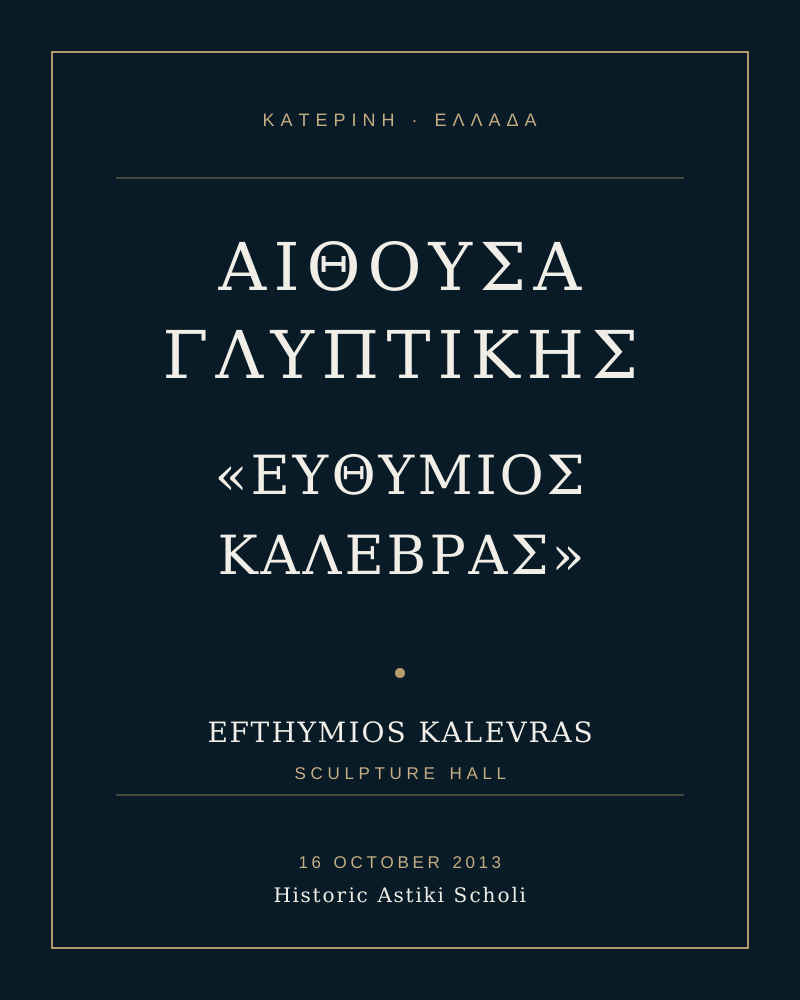
A PERMANENT ROOM IN KATERINI
Visit the Efthymios Kalevras Sculpture Hall
Discover the history of the public collection and enter the room through a new video record.
Enter the Sculpture HallFILM RECORD
The sculptor at work
One of the rare film records of the artist: Kalevras among his works and before an audience, shaping clay by hand, filmed in his native Katachas. The footage survives in low resolution; it is shown here as a restored exhibition copy.
Video: Leandros Tsarampoulidis, Katachas, Pieria · 2012 · Original recording
ARTISTIC VISION
THE HUMAN FIGURE AS A LIVING STRUCTURE
Across Kalevras's work, the human figure is simplified into masses, curves and voids. The female figure, the circle and relationships between two or more figures recur over time, linking monumentality with intimacy.
His practice begins with close attention to material. Stone and marble retain the resistance of the block; plaster preserves the immediacy of modelling; bronze gives those gestures lasting form.
In painting, colour and line extend the same investigation. Dancers, musicians, solitary figures and groups are organised through rhythm, gesture and presence.